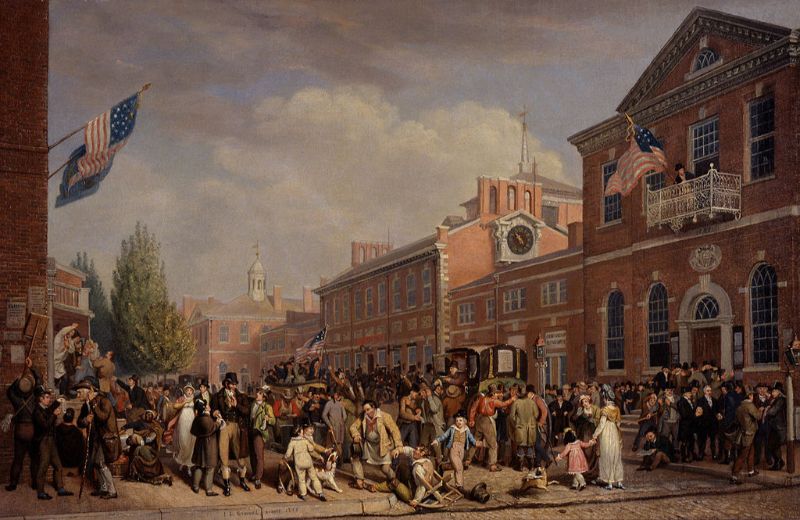
Back in the colonial days of America, elections and the traditions surrounding them were quite different. Because communication was harder in those days, candidates had to campaign in person. In pre-Revolutionary War America, only wealth landowning men could vote, and many times they traveled from all around to take place in elections. Sometimes, elections didn’t even involve ballots, rather people would vote vocally.
In colonial days, individuals running for office would often send letters to potential voters, and occasionally visit them in person at their home. On election day, politicians were expected to be at the place of voting, and to great each voter personally.
The events leading up to elections were also quite different from today. Campaigners would often throw parties. When George Washington ran for the Virginia House of Burgesses in 1758, he gave potential voters alcohol. Prior to voting, Washington provided seventy gallons of rum punch, thirty-five gallons of wine, forty-seven gallons of beer, and two gallons of cider. He won the election with 310 votes.
In New York, it was common for candidates to rent entire taverns and throw wild parties on election day. Once everyone was liquored up, impromptu parades would form as voters walked through the streets to the polling places. Voters who had traveled to town for the election often brought their families, who would watch the mayhem, and sometimes participate. After the election concluded, voters would crowd into the closest tavern, and the winner of the election was expected to provide food and drink. Election cake, a special sweet bread, was also served on election days.
Although they could not vote in official elections, African Americans also held election day festivities. Beginning in the 1700s, free and enslaved African Americans held festivals that included African traditions, foods, and dances. In Boston, African Americans would gather to drink, dance, and gamble on election day. In some cities, African American communities would elect their own leaders, which included sheriffs, a lieutenant governor, and justices of the peace.
Elections weren’t all fun and games, however. Candidates sometimes would bully potential voters, and brawls were not infrequent. One such brawl in Philidelphia broke into a full-scale riot in 1742. In response to rumors that Quaker politicians were cheating in elections, a group of sailors gathered around the courthouse. The sailors, who were pro-Anglican, became violent. The event is now known as the Bloody Election.
Many political academics believe that America should revive the tradition of election day festivities. The fight to make election day a federal holiday is growing in support and some political scientists believe that celebrations can increase voter turnout. Historian Holly Jackson believes that a return to the celebratory spirit of election day is important for the democratic process.