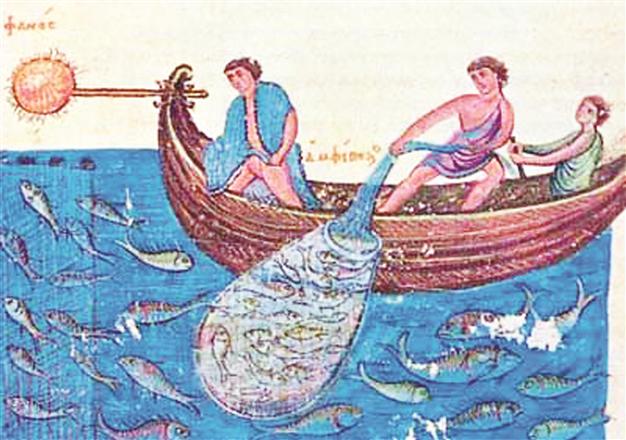
Ancient Mediterranean society relied heavily on fishing to provide food for the huge populations of the Roman and Byzantine Empires. Constantinople itself was a massive port for fishing, with ships that roamed the Black, Ionic, and Agean Seas. The fishermen worked hard, but lived a decent life, especially if they were a part of the guild. They used many techniques still common today, like net and pole fishing, but there was one trick they used that was extremely ingenious.
The bounty of the sea was just as essential to life in the ancient world as it is today. Many of the boats brought in fish like tuna, mackerel, mullet, and anchovies. They also hauled ashore other delicacies like lobsters, scallops, oysters, and shrimp. Caviar was consumed in large quantities in medieval Byzantium by nobles and commoners alike. It was likely a huge part of their intake of protein and essential minerals like iron.
As a result, throughout the Mediterranean and its connected seas, the wrecks of fishing boats litter the seabed. Not only this a reminder of how dangerous fishing operations could be during those times, but it also provides a wealth of preserved information about how the people of the ancient world harvested the marine bounty. One particular seventh-century wreck was found off the coast of Israel, and among its hoard of equipment one item drew interest from historians and archaeologists, a fire basket.
It is believed that some of the more crafty and adventurous fishermen of the ancient world may have gone out at night to find their quarry. This added an element of danger to their profession, but it also greatly increased their chance of reward by avoiding their competitors and beating them to morning markets. One of their more fascinating techniques would be to light these large fire baskets and hang them over the water. The lights would then lure the schools of fish to the surface, making it easier for the fishermen to catch them in their nets.
Catching the fish was not the only challenge the fishermen faced. Once they got their boats loaded, they still had to sell the fish in one of the most regulated markets of the ancient world. The rulers of the city forbade the selling of catch directly off the ships and required that specific locations only could sell raw fish. They did offer an opportunity to sell cooked fish at stalls on the piers. All this was in an effort to prevent underpricing and to make certain proper taxes were paid.
The fire basket technique may have been a rarely used one, as preserved baskets are only an occasional find among the wrecks on the ocean floor. Perhaps it was more dangerous to go out at night, or something that only a few captains knew about. Or perhaps the night fishermen were involved in black markets to avoid the city’s taxes. Archaeologists continue the search for more clues. Regardless, Byzantine fishermen seemed to be way ahead of their time.